Skip to content

2.39:1

In Frame

Property developers

Buyers commit before the building exists. Everything they judge it on, you commission.

Act one: the commercial case

Neon Frame Creative is a UK property marketing agency for developers, working from Leeds and London on new homes, off-plan, build-to-rent and later-living schemes: scheme naming and identity, CGI, film, brochures, microsites and launch campaigns from one studio.

Nobody buys the building. They buy the picture of it.

Off-plan, there is nothing to stand in. A buyer in Singapore and a fund analyst in London are working from the same handful of assets: a CGI, a film, a name, a brochure and a website. Those assets are not marketing decoration sitting alongside the product. For the first eighteen months they are the entire product. Underspend on any of them and you are asking someone to commit six figures to a picture they do not trust.

Identity shows up in the numbers, not just the brochure.

Two schemes on the same road, same specification, same square footage. The one with a name, a story and a coherent look sells from a rate card. The other negotiates. Identity sets the reservation pace, the achieved price per square foot and, the part developers feel last, the calibre of buyer who enquires in the first place. A weak scheme identity is a discount you pay later, quietly, unit by unit.

Planning is a public conversation. You are in it or you are being described in it.

Committees, consultations, residents’ groups and the local paper form a view of a development long before the first spade. That view is built from the hoarding people walk past, the boards at the consultation evening and whichever CGI ends up in the officer’s report. Present the scheme properly and you are a developer with a plan. Present it badly and someone else writes the caption.

A scheme is worth what people can picture. Control the picture.

Evidence

Already made

Work for property developers, made by this studio. Play it, step through it, or open the live site and use it.

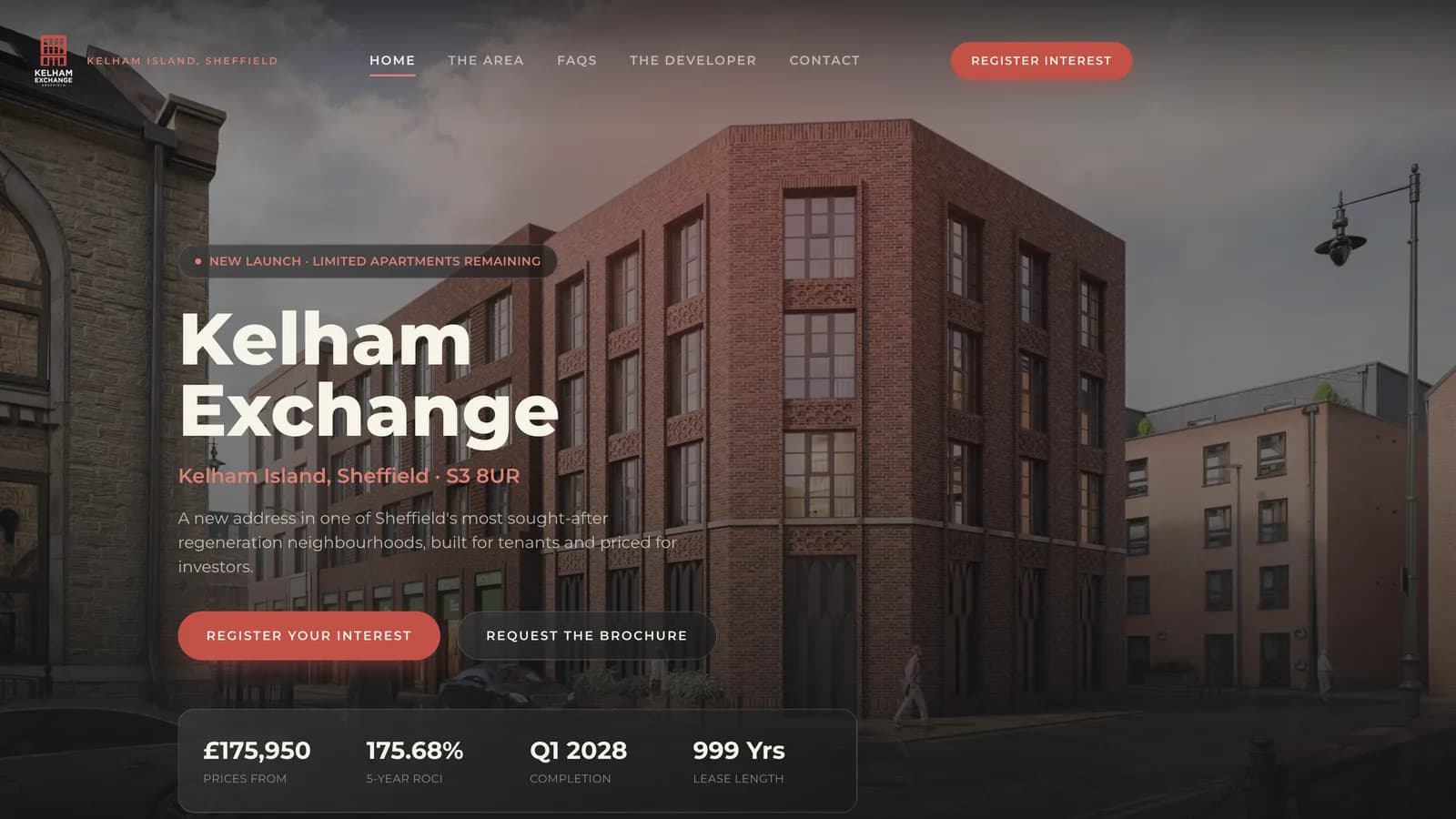
The Kelham Exchange homepage: the scheme name over a CGI of the building, with price from, five-year return, completion date and lease length set along the bottom

Kelham Exchange · Scheme microsite, Kelham Island

The numbers a buyer asks for, above the fold and on a phone.

Web16:9kelhamexchange.co.uk

Sheffield Investment case. The commercial argument for a city, presented to camera and cut for investors deciding from a distance.

CityRise · Sheffield Investment case

The investment case for a city, made in three minutes.

Film16:9

Inside Property · CityRise

From Poland to Property Developer: Building a UK Portfolio from Zero with Dawid Dowbusz

CityRise · Inside Property

Four episodes of the market explained by the people building in it.

Social1:1open.spotify.com

Act two: why Neon Frame

Six disciplines, read through a developer’s programme: from land acquisition and planning, through launch, to the last unit sold.

Scheme positioning

Who the scheme is for, what it is worth, and what it is called. Naming, target buyer, price story and the launch sequence, agreed before anything is designed, so the brochure and the agent are arguing the same case.

CGI, development and area films

CGI and brand films built as one argument rather than commissioned twice: exterior and interior visualisation, drone and aerial context, area and neighbourhood films, construction timelapse, buyer and investor testimonials. Cut long for the sales suite, short for the feed.

Imagery: site, progress and lifestyle

Monthly progress photography that proves the programme is real, area libraries that sell the postcode, and completed show-home and unit stills that carry the scheme into resale and lettings.

Development identity, hoarding and sales suite

The name given a mark, a palette and a type system, then applied where buyers actually meet it: site hoarding and signage, wayfinding, brochures and price lists, consultation boards, and the sales-suite collateral your agents hand over.

Scheme microsites

A site per development that loads on a phone at the hoarding, holds the plots and availability, and captures enquiries in a form your agent will actually work. Built to hand over, not to hostage.

Launch and waiting-list campaigns

Locally targeted launch campaigns, investor-facing content for overseas and portfolio buyers, and steady progress content that keeps a registered list warm through the eighteen months before completion.

Glow, Beam, Halo

Most developers start at Beam for a launch (strategy, a hero film and the assets to run it) and move to Halo across a pipeline, where one identity system and one monthly shoot day serve every live site.

See how the tiers work

Property developers: straight answers

Asked and answered

What is off-plan property marketing?
Off-plan property marketing is the work of selling homes in a development that has not been built yet. Because there is nothing to view, the scheme is sold entirely on commissioned assets (CGI, a name and identity, a brochure, a film and a microsite) supported by evidence that the developer will finish it. It runs from planning through to the last unit sold, and the buyer is assessing the company as much as the building.
Should we brand the development or the development company?
Both, and the company brand is the one that compounds. A scheme identity is spent by the day the last unit completes; a developer brand carries into the next launch and collects proof as it goes, so scheme three goes to market with two finished buildings behind it. Off-plan buyers are underwriting the business as well as buying a flat, and nothing in a scheme brochure answers that. We build the two together so they never contradict each other.
How much does a development brand and CGI package cost in the UK?
Unit count and the number of views drive it. One CGI set or one scheme film is the smallest useful job; a full launch, meaning naming, identity, CGI, film, hoarding and a microsite, is the largest. Pipelines of three or more sites cost less per scheme on a retainer than commissioned one at a time.
When in the programme should a developer start marketing a scheme?
At planning, not at practical completion. The hoarding, consultation boards and the CGI in the officer’s report are all marketing whether you treat them as such or not. Naming and identity agreed before the CGI is commissioned stops the same assets being paid for twice.
Do you produce CGI as well as photography and film?
Yes, both sit inside Imagery. Exterior and interior visualisation, drone and aerial context, construction timelapse and progress photography come from one studio and one brief, so the render and the film argue the same case rather than looking like two suppliers.
Can you work alongside our selling agent and their portal requirements?
Routinely. Agents need specific crops, file formats and floorplan treatments, and portals have their own rules. We deliver to those specifications as part of the package, and the microsite hands over to your team with the enquiry form wired to whoever is working the leads.
How long does CGI take for a residential development?
Allow six to eight weeks from approved drawings to final images for a first set, and less for additional views afterwards. Most of that is not rendering. It is agreeing the camera positions, the materials and the level of finish, then two rounds of amends, which is why the model is built once and lit properly rather than rebuilt per image. Late changes to the architecture, not the render queue, are what actually moves the date.
Do you work on build-to-rent, later living and student schemes as well as homes for sale?
Yes, and the argument changes with the tenure. For sale, you are selling an asset to one buyer. Build-to-rent and student are selling a way of living to a resident and an income stream to an investor at the same time, so the amenity and the operator brand carry more weight than the specification. Later living has to persuade an adult child as often as the resident. Same six disciplines, different case being made.
Which parts of the UK do you work in?
All of it. The studio runs from Leeds and London, and shoot days, site visits and consultation evenings happen wherever the scheme is. Most of our development work to date has been in Yorkshire, the North East and the Humber. CGI, identity, brochures and microsites are made in the studio and are not tied to a location at all.

Put your next development in frame

Send us the site, the programme and the sales target. We will come back with what we would shoot, what we would name it, and what it costs.