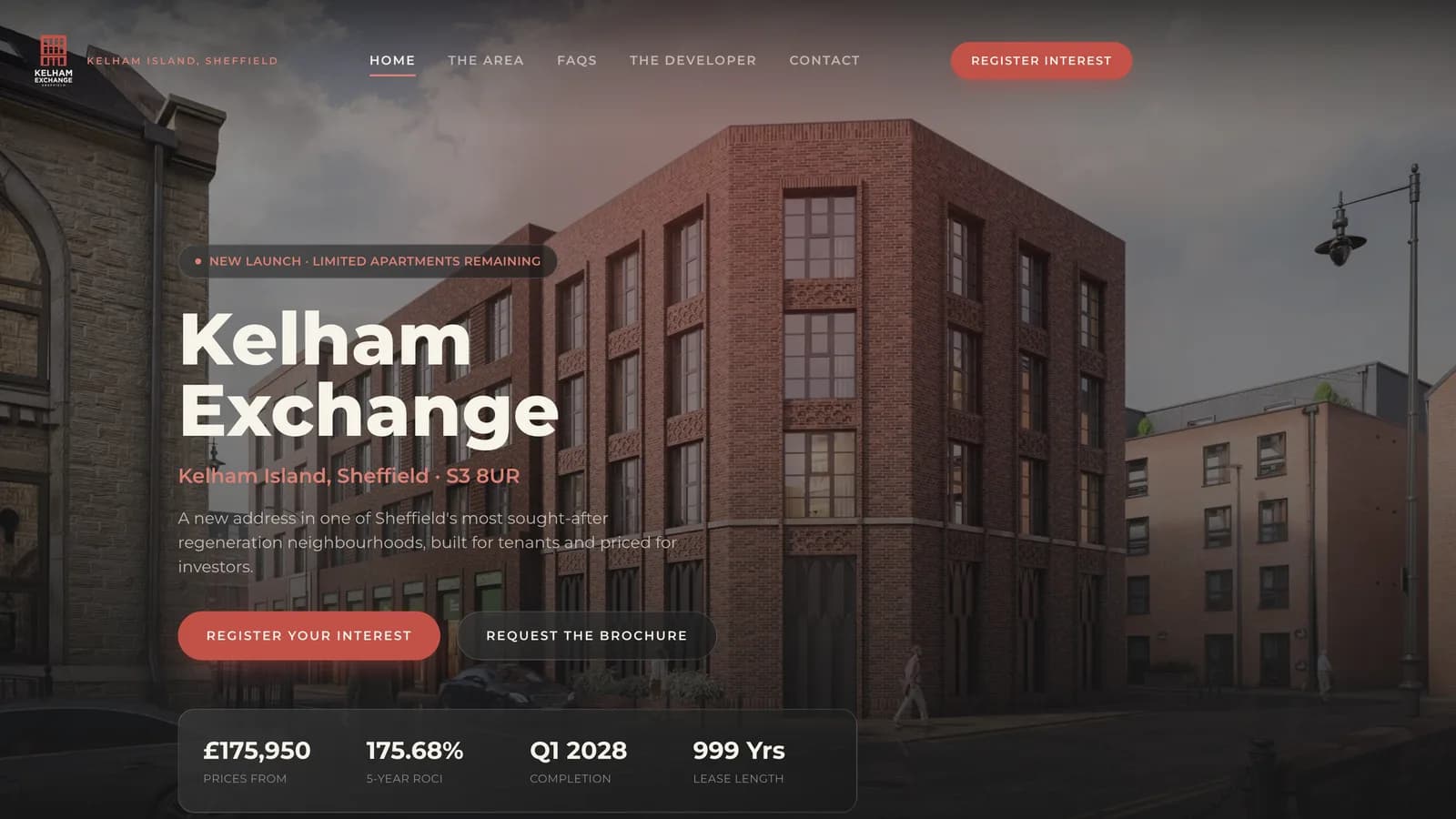
Kelham Exchange · Scheme microsite, Kelham Island
The numbers a buyer asks for, above the fold and on a phone.
Webkelhamexchange.co.uk


It gets read at the hoarding, on a phone, at nine at night. Everything else about it is secondary to that.
A development microsite is read in one place more than any other: outside, on a phone, by someone who has just walked past the hoarding or been sent the link by an agent. Often at night, when the office is shut and the only thing answering is the page.
That is the whole design brief. Everything else follows from it.
Six things, above the fold, on a phone. Not on a laptop, where everything fits and nothing is being tested.
That is the list. Anything missing from it costs you an enquiry at nine o'clock at night, because the person reading has three other schemes open and the one that answers first wins the call in the morning.
Everything else is the second screen and below: the CGI set, the area, the specification, the enquiry form, the developer's own story. All of it matters. None of it matters before the six.
The numbers a buyer asks for, above the fold and on a phone.
Webkelhamexchange.co.uk
Kelham Island in Sheffield, where the competition is other converted and new-build apartment schemes within about four streets of each other, and where the buyer is an investor rather than somebody who will live there.
Open it on a phone rather than reading about it here, because that is the only honest test of anything on this page. The first screen is the name, the address and four numbers: price from, a five-year return, the completion quarter and the lease length. No numbers are repeated here on purpose, because they move as the scheme sells and a page that quotes them goes stale without anyone noticing.
The CGI runs underneath rather than on top. An image is what makes somebody stay and a number is what makes them arrive. Below that, the area section does the job the scheme cannot do for itself: Kelham Island is the reason to buy in Kelham Island, and a scheme that only argues for its own specification is arguing the smaller case.
Measured against the six above, it carries four and changes two on purpose. There is no agent's number, because this one sells direct and the first screen asks you to register instead. And availability reads as limited rather than as a count.
That second one is worth sitting with, because it contradicts the rule two screens up. The count works on an owner-occupier scheme, where it creates a reason to ring today. On an investor product it reads as a stock level, and an investor who watches a number drop for six weeks concludes the thing is not selling rather than that it is. Same list, different buyer, one item inverted. The list is a default, not a law.
A microsite that takes four seconds on a phone on 4G outside a building site has already lost to the one that took one. This is not a developer preference. It is the difference between an enquiry and a back button, and it is measurable before launch rather than guessed at after.
The two things that cost the most time are images that were never resized and a page that waits for something before it shows anything. Both are decisions, not accidents.
This is the part that gets left to the end and should be settled at the brief, because it is a negotiation when the site exists and a formality when it does not.
Agree in writing: who the domain is registered to, whose hosting account it sits in, who holds the code, who is licensed to use the images and for how long, and where the enquiries go. That last one sounds trivial and is not. An enquiry form that posts into the builder's inbox rather than the agent's is a lead that arrives a day late, every time, for the whole sales period.
The position we take is that it is your site. Built to hand over, not to hostage.
A scheme microsite has a defined life and almost nobody plans for the end of it. The domain renews, the content ages, and three years later a buyer searching your developer name finds a page offering apartments that sold out in 2027.
Decide at the start which of the three it becomes: a completed-scheme page under your own brand, a redirect to one, or a site kept live for resale and lettings. Each needs different content and all three are cheap to write while the scheme is live. None of them is cheap to retrofit.
Straight answers
Send us the site, the programme and the sales target. We will come back with what we would shoot, what we would name it, and what it costs.